
Whether you have just started taking the first steps in your family history exploration, or are many years into the journey, this book will help you find the right path – and stick to it.
Dr Karen Cummings gently leads you through the best practices – from tips for working efficiently, ensuring your research steps have been thoroughly exhaustive, to pulling findings together in a report, and organising your files (electronically or paper-based) in a systematic order.
Across 11 chapters, Karen covers every aspect of the process of researching family history, which will prove useful to both professional genealogists and enthusiastic hobbyists alike. The book includes case studies, and is full of pictures and diagrams to help illustrate various approaches and techniques.
Methodology is the heart of this book, and it is clear to see the passion for meticulous scrutiny of documents, analysis and evaluation. It emphasises the importance of identifying exactly what a record tells us, but also what it does not, drawing reasonable conclusions based on evidence and inferred information. There is guidance on how to recognise gaps in our own research and those in original record collections, with advice on how to work around missing data, which is invaluable when faced with a brick wall.
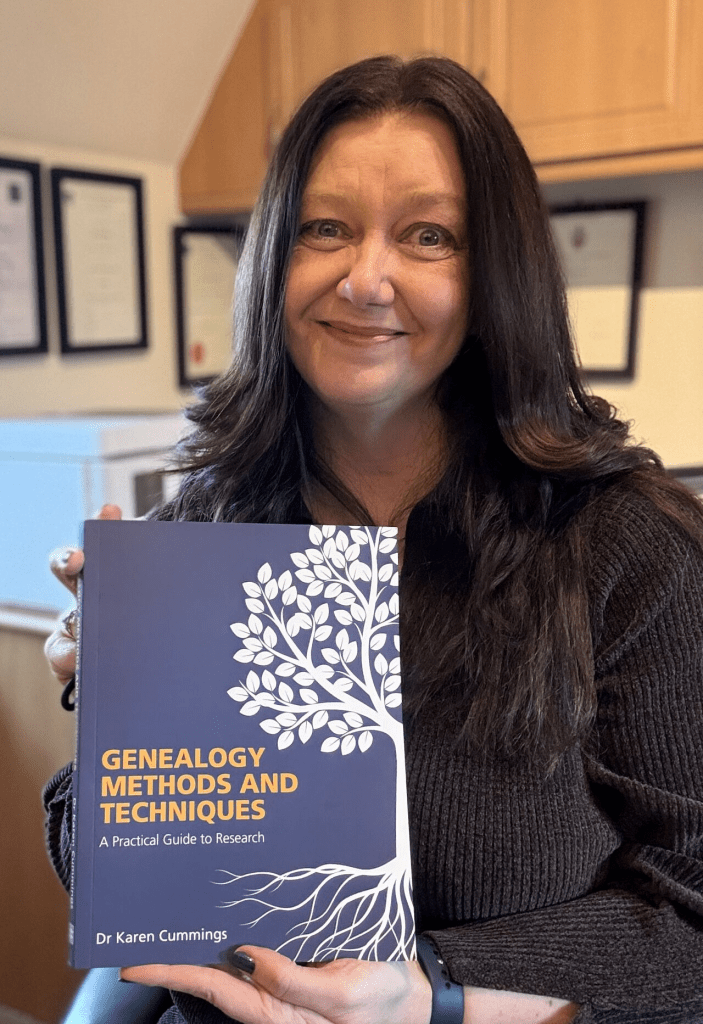
I particularly love the fact that Karen suggests a variety of methods and tools, without pushing which is the ‘correct’ one. She allows the reader to decide which works best for them, whilst considering the benefits and shortcomings of each, in a well-balanced appraisal.
We all have our own preferred way of working, and I hold my hand up and admit that I am rather stuck in my ways, but this book has opened my eyes to some small changes that will improve my productivity and help keep me focused.
I have shelves and shelves of genealogy books, but this one will be joining a treasured few that will remain next to me on my desk.
 Who Am I? Family Tree Research