
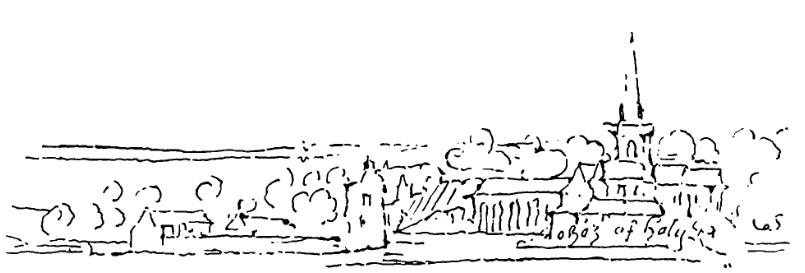
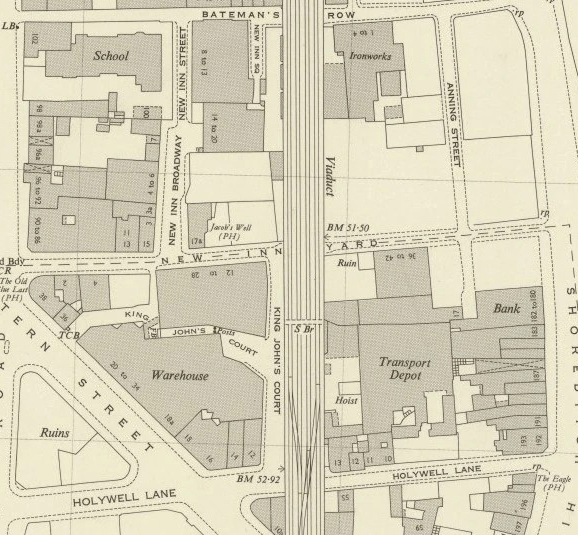
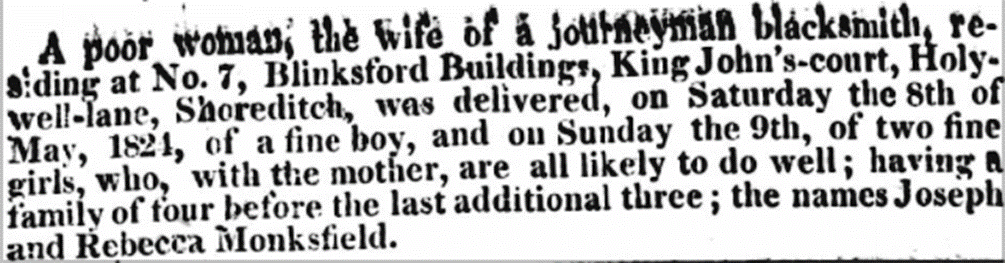
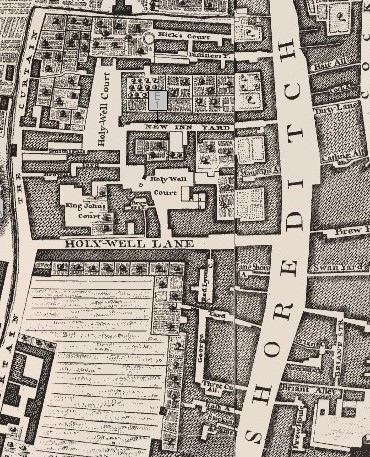
As you may have seen in one of my previous blogs, I have registered a One-Place Study for King John’s Court, Holywell Lane, Shoreditch. My Monksfield ancestors resided at the address in the early 1800s, and the local area was home to my family for many generations. Holywell Lane has a fascinating history, some of which I detail in my previous article; but today I would like to tell you about Holywell Priory, which stood on the site from the early-mid 12th Century (the exact date being cause of contentious debate between historians), until it’s Dissolution on 10th October 1539.
Holywell Priory was dedicated to St. John the Baptist, and became home to an order of Augustinian nuns. A complete record of the Prioresses of Holywell is not yet established, but the Survey of London: Volume 8, Shoreditch, The Augustinian Priory of St. John the Baptist, Holywell,1 presents the following list, created from various sources:
- Magdalena, circa 1185 or circa 1210
- Clementia, 1193 – 1203
- Maud, 1224
- Agnes, 1239 – 1240
- Juliana, 1248 – 1261
- Benigna, ?
- Christina of Kent, 1272 – 1283
- Alice, 1293
- Albreda, circa 1320
- Lucy of Colney, 1328 – 1330
- Mary of Stortford, 1330 – 1334
- Theophania, 1336
- Elizabeth Montacute, 1340 – 1357
- Ellen, 1362 – 1363
- Isabella Norton, 1387 – 1392
- Edith Griffith, 1400 – 1409
- Clementia, 1440 – 1444
- Joan Sevenok, 1462
- Elizabeth Prudde, 1475
- Joan Lynde, 1515 – 1534(?)
- (Clemencia?)
- Sybil Newdegate, 1535 – 1539
(more about these Prioresses in a future blog)
Due to the lack of extant records, there are many disparities among historical texts regarding the origins of Holywell Priory, but it is largely accepted that the founder was Robert Fitz Generan (or Gelran) the second known holder of the prebend of Holywell or Finsbury in St. Paul’s Cathedral, who ‘… gave the nuns the site for their monastery, being the ‘moor’ in which the spring called Haliwell rose; it was reckoned to contain 3 acres, and a rent of 12d. a year was payable for it.’.2
The priory played an integral role in the community, not least by caring for the poor, as we can learn from historian John Stow. Following the Great Fire of London, the ecclesiastical historian and biographer John Strype published a new, expanded version of John Stow’s Elizabethan classic A Survey of London, describing the dramatically transformed landscape of the capital. In a chapter devoted to the Life of John Stow, Strype tells of Stow’s resentment of a property developer who converted some almshouses once owned by the priory, ‘Where was a Place, called Rotten-Row, consisting of small Houses with Gardens; which belonged to the Priory of Haliwel: Who placed there a great many Poor that dwelt there freely, only paying a Peny as an Acknowledgment to him at Christmas; who then feasted them all at the Priory with good Cheer. Afterwards, when that Priory was dissolved, these Houses, with the rest of the Revenues, were swallowed up; and came at length into the Hands of one Russel: who bought them a good Penyworth; and new builded them. And now was the Case quite altered; and there, where Charity and Relief was exercised, now became a Place of Rigor and Covetousness. For this Man made his Bargains so hardly with his Carpenters, Bricklayers and other Workmen, that they were undone by it: and then so rented these Buildings, and took such large Fines of the Tenants, that it came to near as much as the Houses cost him. And yet the Place was now from Rotten-Row, called Russel-Row, in Honour of his Name; as Stow smartly reproacheth him.‘3
As was common practice during the medieval and early modern period, in order to absolve your soul of sin and secure your place in heaven, you would make bequests in your will to gift property to the Church upon your decease. Royal charters reveal the priory inherited lands across the south east of England, within the counties of Bedfordshire, Essex, Hertfordshire, Surrey, Cambridgeshire, Kent, Norfolk, Suffolk and the City of London. By the time of the Dissolution, the priory had scattered holdings in no less than 40 city parishes.
It was rather interesting to learn that for five years after the priory was dissolved, the nuns were permitted to continue living in a portion of the broken estate, and were in receipt of pensions. In 1544 however, King Henry VIII granted the nun’s share of the precinct to Henry Webb, gentleman usher to Queen Catherine (Parr). The site was demolished over time to make way for London’s rapidly growing population, and by the end of the 1700s, all that was left of the priory were fragments of ruins.

The Museum of London Archaeology (MOLA) has conducted excavations of the area, and discovered some rather interesting finds including Neolithic/Bronze Age and Roman artefacts, 16th Century German stoneware jugs, and a Witch Bottle. ‘The red brick floor tiles had been removed and a large hole dug in the doorway of a basement or latrine. The bottle was then upright placed in the hole and the hole backfilled with earth. The tiles were then carefully relaid, but on a slightly different alignment, so it was clear the area had been disturbed. This ritual placing or concealing of an ordinary household object alerted the archaeologists to the probability that this was folk magic. It could be a charm or witch-bottle, used to protect and ward off evil.‘.4
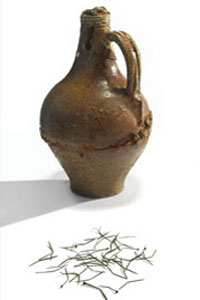
Witch bottles were used throughout the 17th Century (the height of witch hunts and trials), and are believed to have contained remedies to protect against witchcraft. They often contained nails, pins, thorns, human hair, even urine, and were placed beneath floors or in hearths. This bottle held a number of very fine bent copper alloy pins with wound wire heads, the remains of rusty nails and what may be a piece of wood or bone.
Picture from MOLA https://www.mola.org.uk/blog/holywell-witch-bottle
There are many more stories to tell of Holywell Lane, and I look forward to sharing my discoveries with you in the future. In the meantime, if you have any information about this little corner of Shoreditch, please do get in touch.
Sources
1‘The Augustinian Priory of St. John the Baptist, Holywell‘; pages 153-187 of Survey of London: Volume 8, Shoreditch; Ed. James Bird; Published by London County Council, 1922; accessible via https://www.british-history.ac.uk/
2‘Religious Houses: Houses of Augustinian canonesses‘; pages 170-182 of A History of the County of Middlesex: Volume 1, Physique, Archaeology, Domesday, Ecclesiastical Organization, the Jews, Religious Houses, Education of Working Classes To 1870, Private Education From Sixteenth Century; Ed. J. S. Cockburn, H. P. F. King and K. G. T. McDonnell; Published by Victoria County History, London, 1969; accessible via https://www.british-history.ac.uk/
3‘The Life Of John Stow‘; Preface 5, page 42, paragraph 2 of A Survey of The Cities of London and Westminster; by John Strype; 1720; Electronic version; accessible via https://www.dhi.ac.uk/strype/index.jsp
4Holywell Witch Bottle, Museum of London Archeology, blog post, 01.07.2008, accessible via https://www.mola.org.uk/blog/holywell-witch-bottle
The header image at the top of the page is a sketch of Holywell Priory circa 1540, from Wyngaerde’s Panorama of London





 Who Am I? Family Tree Research